Master Claude Cowork, MCP, and multi-agent automation to offload research, content, coding and reporting — and reclaim hours every week.
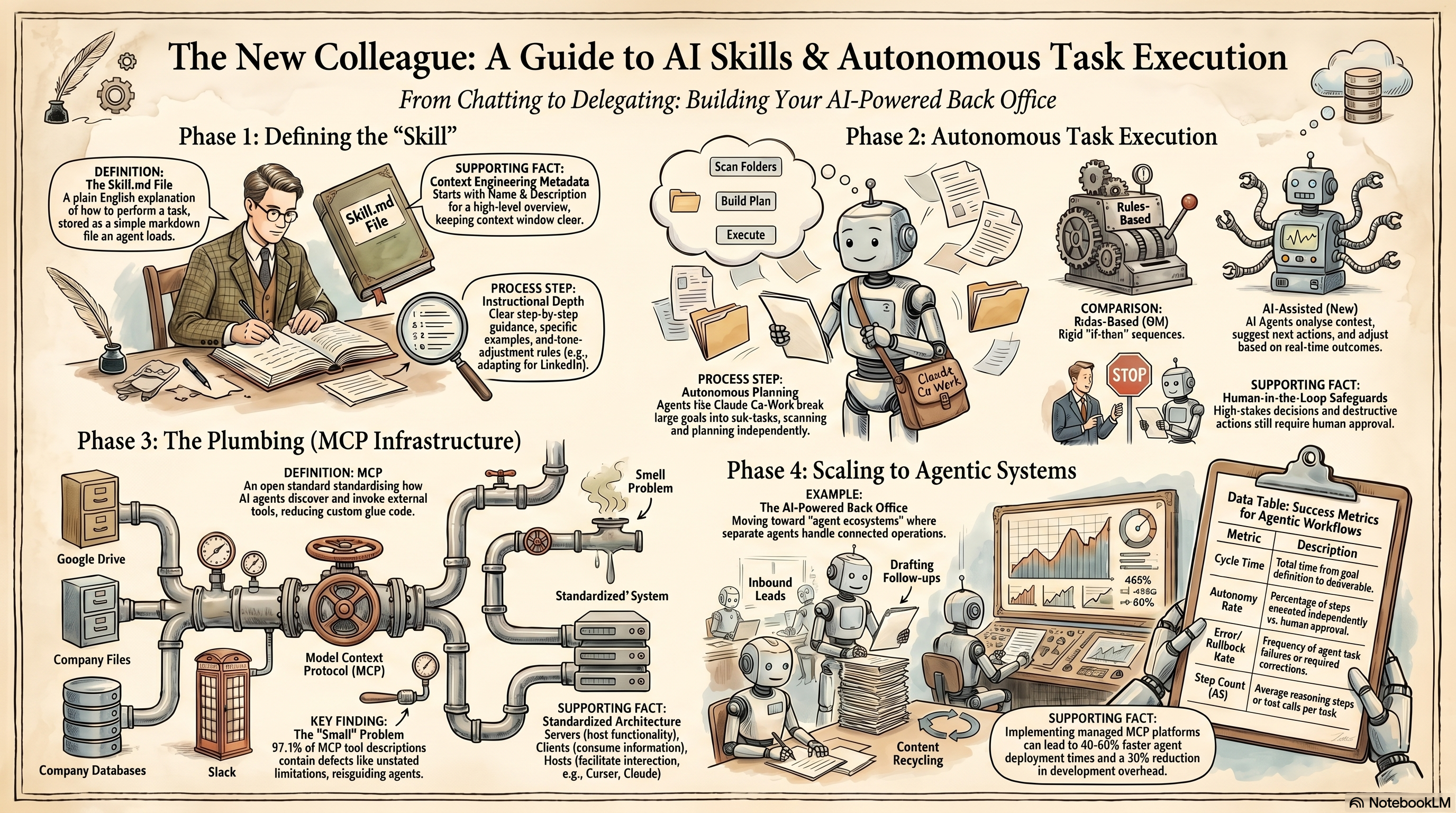
Get a free inside look at “Skills, Agents & Task Execution” — the module infographic and the video overview.
By the numbers
Move from scattered lessons into repeatable workflows, decision checkpoints, and practical learner assets.
Every module maps to a concrete operator workflow, learner lab, and reusable asset.
Course markdown, trainer resources, student guides, and lead magnets are distilled into buyer-ready messaging.
Use the checklists, guides, and templates to ship work during the course instead of waiting until after it.
Claude holds an estimated 42% share of enterprise coding workloads (more than double OpenAI's 21%), with 70% of Fortune 100 companies using Claude.
Controlled studies show developers complete tasks 55% faster with AI assistance, and a 1,000-organization study found 39-49% higher programming activity with no drop in quality.
11 modules, each ending in a deliverable.
Cowork is Anthropic's environment for running Claude as an autonomous, multi-step agent rather than a single-response chatbot. It can plan, use tools, take a series of actions and coordinate other agents, with human oversight at the points that matter.
The Model Context Protocol (MCP) is the open standard for connecting AI agents to your tools and data, introduced by Anthropic in November 2024 and now governed by the Linux Foundation. It's the integration layer that lets one agent securely reach your CRM, files, code and APIs, so we treat it as foundational.
No. It's designed for founders, operators and knowledge workers. You'll learn to orchestrate agents, connect tools via MCP and design safe workflows; coding ability helps but isn't required, and a major 2026 trend is exactly non-technical people building their own automations.
Yes. The core concepts, MCP integration, multi-agent orchestration and human-in-the-loop design, are vendor-neutral. MCP has first-party support across Claude, ChatGPT, Gemini, Microsoft Copilot, Cursor and VS Code, so the patterns carry over.
Instead of one model working sequentially, a multi-agent system uses an orchestrator to coordinate specialized agents working in parallel, each with its own context, then synthesizes the results. It's how teams now compress tasks that used to take hours or days, and inquiries about it surged 1,445% between early 2024 and mid-2025.
Production deployments converge around a median of about 6.4 hours saved per knowledge worker per week, with senior practitioners saving 10-12 hours. Document-heavy work sees the largest gains, contract review down 60-80% and research synthesis up to 50% faster.
Risk is managed through design: permission allowlists, spend and retry budgets, audit trails, post-action verification and clear escalation paths. The course makes these guardrails a default part of every workflow you build.
Analysts estimate 40%+ of agentic projects may be canceled by 2027, but roughly 77% of failures are organizational, poor scoping, no agreed definition of success, weak governance, not the technology. The course is structured around those success factors so your projects actually reach production.
Well-run agent deployments typically hit payback in 4-9 months, with the fastest seeing positive ROI within 6 months. Vendor-deployed agents reach positive ROI about 2.4x faster than custom builds, which is why the course favors practical, fast-to-value workflows.
The clearest-ROI use cases are document processing (contract review, invoice extraction, summarization), research synthesis and competitive intelligence, financial and status reporting, code assistance, and meeting summarization, all high-volume, language-heavy tasks with human review before final use.
Yes. Skills and plugins are reusable capabilities and connectors you give an agent so it can perform specialized tasks consistently. You'll learn to use and build them so your agents work the way your business actually operates.
The curriculum is built on 2026 developments, MCP's move to the Linux Foundation, Claude's managed multi-agent orchestration features, and the latest enterprise adoption and ROI data, with emphasis on durable patterns over fast-changing model specifics.
Documented outcomes include 39-49% higher programming output with no quality drop, 55% faster task completion, contract review cut 60-80%, and successful deployments averaging around 171% ROI. Claude Code alone reached an estimated $2.5B run-rate within about ten months of launch.
Founders, operators and knowledge workers who want to automate meaningful parts of their own work in 2026, especially anyone managing research, content, reporting, operations or light coding who wants to move from ad-hoc prompts to reliable agentic workflows.
Founders, creators, marketers, operators, and AI builders who want practical workflows they can ship.
Start with the syllabus, then move into the first operator sprint.